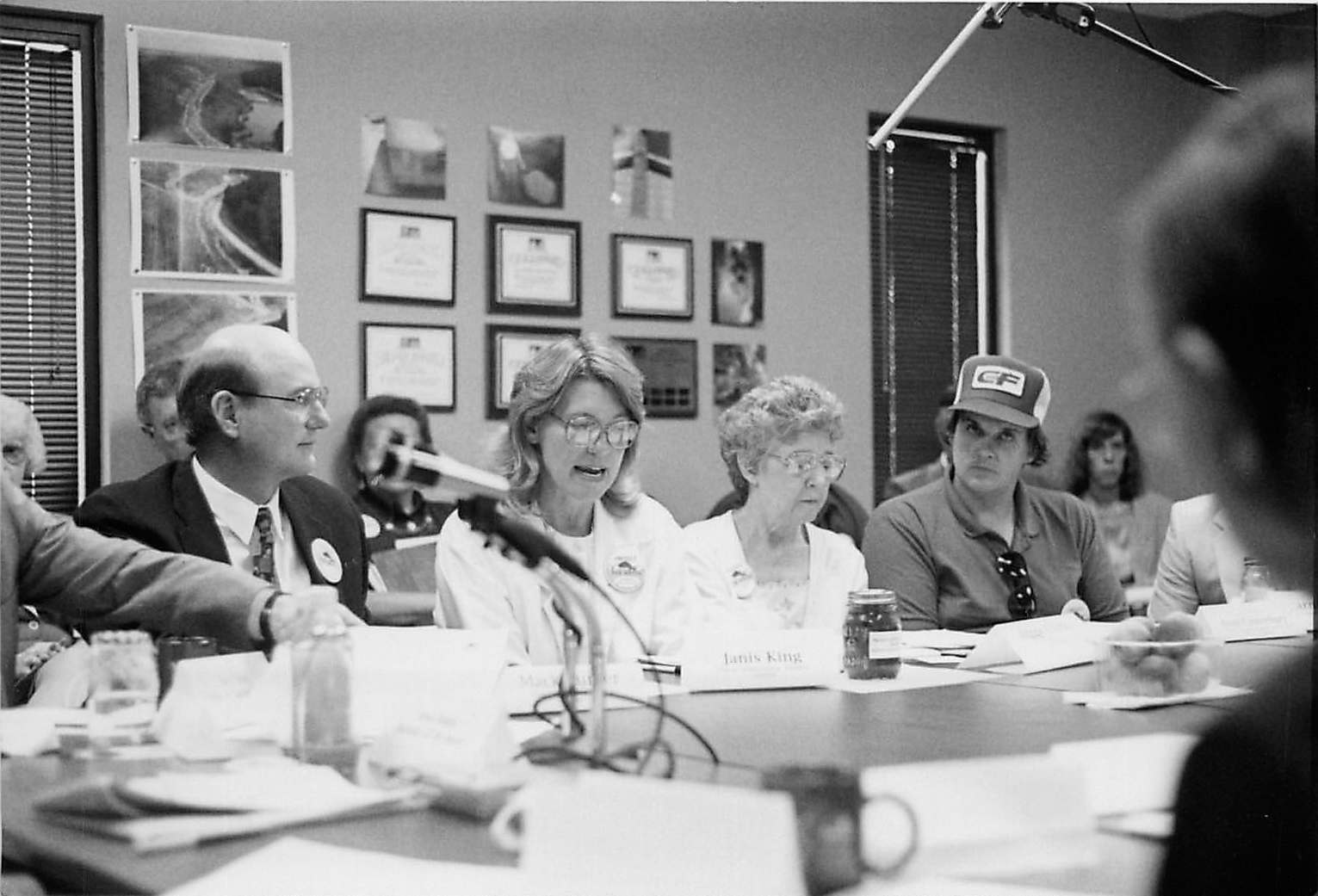
For decades, coalfield communities endured the environmental abuses of unregulated mining: contaminated water, damaged land, and threats to their health and homes. In 1977, citizens across the country fought for and won the passage of the Surface Mining Control and Reclamation Act (SMCRA), a law meant to finally rein in the coal industry.
But a decade later, it was clear that SMCRA’s protections were not being enforced. More than 200 groups and individuals united to demand action, and out of that movement, seven organizations founded Citizens Coal Council (CCC) to defend the people, land, and water most affected by mining.
CCC was created to confront the core injustice in the coalfields: the stark imbalance of power between the coal industry and the communities it impacts. We work to ensure that this imbalance no longer allows industry to degrade the environment, silence citizens, or ignore the laws designed to protect them.
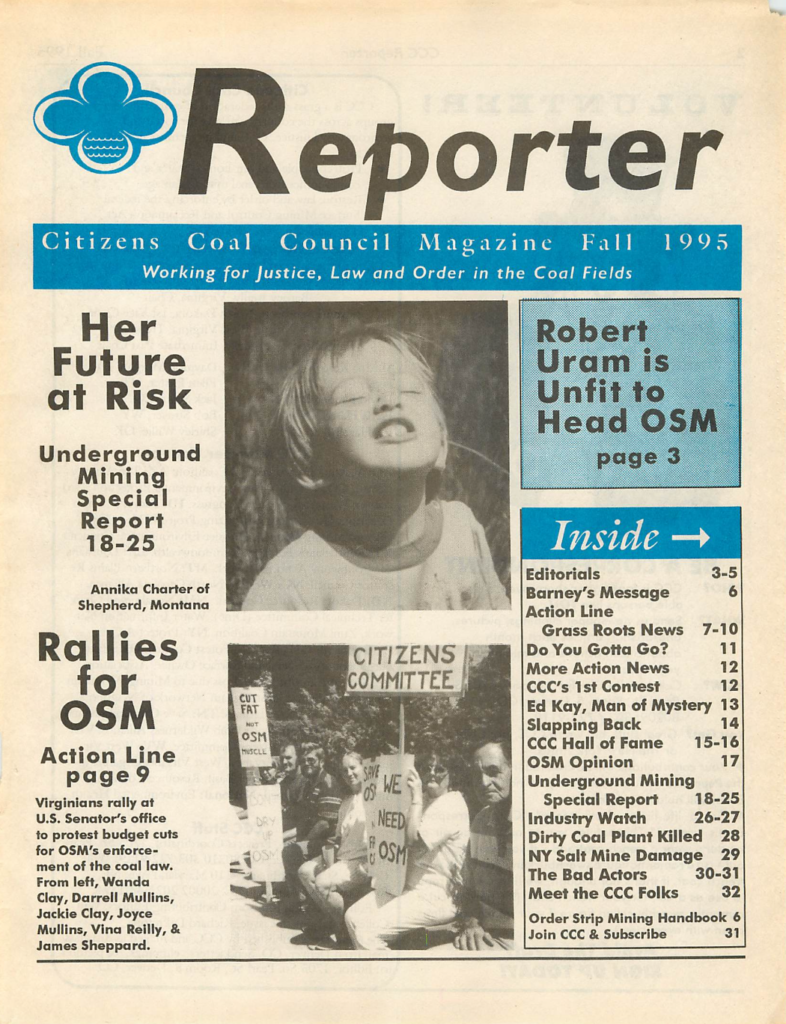
Newsletters that tell the story of a movement in real time.
Our Accomplishments
1987-1989
1987
On the 10th Anniversary of SMCRA 200 citizens gathered in Kentucky and decided to work together for enforcement of SMCRA and for water protection.
1989
Kentuckians for the Commonwealth (KFTC) formed CCC with the help of six other grassroots groups from Illinois, the Navajo Nation, Pennsylvania, the Rocky Mountain region, Tennessee, and Virginia and initiated the “Clean Streams” program. CCC was a project of KFTC.
1990-1992
1992
CCC won a new law (a “flea on passing dog amendment”) to protect homes and water from mining.
1993
Protecting Homes and Parks From Mining: The Kentucky Resource Council (KRC) worked with other groups in 1993 to counter a federal proposal to open up national parks and buffer zones around homes and cemeteries to underground and strip mining.
1994-95
Clean Streams: CCC and its members groups (most prominently the West Virginia Highlands Conservancy) convinced the Office of Surface Mining to create the Appalachian Clean Streams Initiative (ACSI) and won about $10 million a year for cleaning up acid mine drainage. Acid mine pollution is the greatest threat to water quality in Appalachia; ACSI aims to clean up acid mine drainage from abandoned mines and prevent further destruction from acid run-off.
SMCRA Enforcement: Citizens Coal Council (CCC) joined Navajo residents in filing a joint citizens’ complaint against Consolidated Coal (CONSOL), operating in Burnham, New Mexico. The complaint resulted in individual fines of $198,000 against each of its 18 directors for “knowing and willful” violation of SMCRA.
The Office of Surface Mining Reclamation and Enforcement (OSMRE) was not enforcing SMCRA at mines in Arizona and New Mexico. In the mid-1990s CCC appealed two decisions to the Interior Board of Land Appeals (IBLA). The ILBA appeals failed.
CCC hired full time staff in 1994 and incorporated as a 501(c) (3) in 1995.
1995-96
CCC defeated the attempt by the coal industry, state governments and the Clinton Administration to weaken SMCRA provisions on citizens’ rights and reclamation.
1997
Reclamation Enforcement: In a multi-year enforcement effort CCC actively participated in legal actions in the late 1990s against OSM for failure to take enforcement action against Appalachian coal operators over the failure of contract miners to reclaim. The cases involved mountaintop removal abuses, acid mine drainage, subsidence damage, and other reclamation failures. These actions resulted in performance of reclamation and the payment of more than $10,000,000 in civil penalties.
CCC had 30 member groups by the 20th anniversary of SMCRA in August of 1997. CCC started the “Jobs & Justice” campaign and obtained an additional $35 million for cleaning up abandoned mines (AML lands).
1998
Mountain Top Removal: West Virginia Highlands Conservancy, a CCC member group, and coal field residents filed Bragg v. Robertson in the US District Court, S.D. West Virginia to challenge mountain top removal coal mining.
CCC expanded issues to power plant waste (PPW), full cycle of coal, corporate campaigns and intense media training. 1998-2002: CCC won additional $65 million for AML cleanup.
1999
Mountaintop Removal Litigation: West Virginia US District Judge Charles Haden ruled in Bragg v. Robertson that the Surface Mine Control and Reclamation Act (SMCRA) and the Clean Water Act banned most valley fills and that new rules by the EPA and the Army Corps of Engineers allowing mines to ignore stream buffer zones (SBZs) and to fill streams with rock and dirt stripped off mountain tops violated the intent of Congress. Find the text of Bragg v. Robertson at http://www.wvsd.uscourts.gov/
CCC coordinated the defeat of Sen. Byrd’s “rider” designed to overturn Judge Haden’s ruling by weakening SMCRA and the CWA for the benefit of mining firms engaged in mountain top removal (MTR).
Valid Existing Rights: Kentucky Resource Council (KRC) drafted comments on the definition of “valid existing rights” (VER). The Department of Interior (DOI) defined valid existing rights narrowly, preventing mining close to homes, churches, cemeteries, public parks and wilderness areas. The National Mining Association (NMA) challenged the regulation and CCC joined other groups in the lawsuit to ensure that the DOI did not deliberately lose the case.
2000-2002
2000
Corporate campaign training initiated.
Power Plant Waste (PPW): To help protect water resources from the coal cycle, CCC secured $100,000 in funding for a two-year Power Plant Waste campaign and began work with Hoosier Environmental Council (HEC), other member groups, and allies to organize around the issue of power plant waste dumps. With the assistance from HEC a quarterly newsletter, Power Plant Waste, was distributed to over 1,200 people.
The United States Environmental Protection Agency completed a draft determination that would decide if federal safeguards should be required for the disposal of waste generated from the combustion of fossil. The EPA asserted that little information existed that demonstrated dangers posed by Coal Combustion Waste (CCW) or ecological damage resulting from disposal of the waste. Citizens Coal Council and Hoosier Environmental Council commissioned a study, Review of Global Adverse Environmental Impacts to Ground Water and Aquatic Ecosystems from Coal Combustion, by Virginia Tech University to assess the toxicity of CCW and the ecological damage that the EPA may hove overlooked.
The release of Laid to Waste: The dirty secret of combustion waste from America’s power plants by Citizens Coal Council, Hoosier Environmental Council and Clean Air Task Force.
2001-02
Hired field organizer. Worked Media campaigns.
Corps of Engineers Nationwide Permit Reissuance: Kentucky Resource Council (KRC) commented critically on the proposal by the US Army Corps of Engineers to reissue “nationwide permits” authorizing a number of activities whose impacts on streams, rivers and wetlands are considered “minimal.” Many of the Councils comments are in specific opposition to continued authorization of Nationwide Permit 21, by which the Corps of Engineers avoids individual review of proposals to fill in streams and rivers with coal waste and overburden from mining operations.
Mine Permit Rescinded: The Illinois Department of Natural Resources rescinded permits for SilverCreek Construction Co.’s Bear Mine. The mine received a $99,000 economic development grant in 1999 and mining operations had already began on prime farmland when Citizens Organizing Project (COP) made a stink that SilverCreek had not applied for the needed NPDES permit and had failed to file the required farmland reclamation plan.
2002
In June, CCC and 14 other citizen and environmental groups sponsored a landmark event in the coal movement: the Citizens Coal Summit in Charleston, West Virginia. This summit explored the true cost of coal and for the first time in history, brought 200 activists on coal mining, power plant waste, air pollution, human health, and alternative energy together to understand and collaborate on eliminating the impacts of the full cycle of coal.
Sediment: In November, Kentucky Resources Council (KRC) filed the opening brief in the case of Citizens Coal Council & Kentucky Resources Council v. EPA. CCC and KRC are challenging the final EPA rule relaxing sediment controls for western coal mines, and the EPA rules implementing the 1987 “Rahall” amendment. The EPA rules undercut effective regulation of sediment loading from coal mines, replacing enforceable permit limits with “best management practices” that the agency itself admits are unenforceable and unpredictable.
Mountain Top Removal: Judge Haden II, District Court for the Southern District of W. Virginia in KFTC v ACE held that section 404 of the CWA does not allow filling streams with mine spoil materials. ACE appealed and unfortunately won in 2003.
Bragg v. Robertson: The W. VA. DEP, U.S. Army Corps of Engineers, the coal industry, and the United Mineworkers appealed to the 4th U.S. Circuit Court to overturn Judge Haden’s 1999 ruling in Bragg v. Robertson that stopped miners from filling streams with rock and dirt stripped off mountain tops. The 4th Circuit in 2001 did not rule on the merits, instead it ruled that the 11th Amendment denies federal courts jurisdiction over state agencies like the W. VA. DEP even though SMCRA specifically allows citizens lawsuits in federal courts against state agencies charged with mine permitting and regulation. The US Supreme Court in 2002 ignored the citizens’ appeal and let the 4th Circuit’s decision stand.
Sludge Impoundment Action: In response to a citizen complaint filed in May by the Harlan County Chapter of the Kentuckians for the Commonwealth (KTFC) and the Kentucky Resources Council (KRC), the federal Office of Surface Mining inspected the Harlan-Cumberland Coal Company Turkeypen Impoundment and issued a federal Notice of Violation requiring the company to cease pumping water and slurry into the coal waste impoundment. The order also required also the company to improve monitoring of the volume of water discharging from the underground mine, and that the company either obtains approval for the increased pool elevation or by September 10, 2002 have reduced the elevation to the approved level of 1738 feet.
Mining Permit Reversed: When Nally and Hamilton Coal Company began hauling coal on the narrow residential Colliers Creek Road in Partridge, KY, the community endured the noise, the fumes, the dust, the disruption of their lives on a daily basis. Rebecca Boggs had the courage to stand up for herself and her neighbors and demanded that the use of the road be stopped unless it was brought under a mining permit. The state Cabinet refused to take action based on a “public road” exemption that was struck down by a federal judge in 1985 as being inconsistent with the mining law. The federal Office of Surface Mining, which had failed to make Kentucky change their regulation, took no action.
On August 9, 2002, a hearing officer for the state Office of Administrative Hearings issued a Report and Recommendation in her favor, requiring that the state use a test that focused on the extent of and damage from coal-related use of the road as well as public use. On September, 2002, Natural Resources Cabinet Secretary James Bickford adopted the recommendation of the Hearing Officer that the state agency must consider the extent of and damage from coal-related use of the road as well as public use, when determining whether a coal company whether the use of a public road for coal haulage by the company requires obtaining a permit for that road. The decision clarified that for any future decision on whether to require a road to be permitted (and which in turn would require waivers from each resident within 300-feet of the road), the agency must consider the coal-related use and impacts on the road rather then focusing on the amount of public use.
Cumulative Hydrologic Impact Assessments (CHIA): CCC joined Ohio River Valley Environmental Coalition (OVEC) and others in litigation to challenge how West Virginia performed cumulative hydrologic impact assessments (CHIA), required by SMCRA to prevent harm to a watershed by multiple coal operations, none of which would cause damage standing alone. Appellate courts in 2005 and 2006 upheld the trial court decision for the environmental groups.
Applicant Violator Enforcement: On behalf of Kentucky Resources Council, Inc. and Citizens Coal Council, Attorney Walt Morris submitted comments opposing a proposal by the Office of Surface Mining Reclamation and Enforcement (“OSM”) to allow applicants for mining permits to conceal from regulators and the public the identities of persons who have the actual ability to determine the manner in which the permit applicant will conduct mining operations. The OSM proposal would hamper the decision making process of regulatory authorities on whether to deny permits to corporations that own other corporations currently in violation of environmental laws.
Subsidence: CCC won a court decision protecting homes and historic places from subsidence.
SMCRA, § 1272(e), prohibits “surface coal mining operations” in national parks and other protected areas. Contrary to OSM’s interpretation, CCC and the National Trust for Historic Preservation argued that § 1272(e) also prohibits subsidence and underground mining activities that may cause subsidence under or adjacent to schools, churches, homes, cemeteries, and other surface features. The District Court in the District of Columbia decided for CCC in 2002. OSM and NMA appealed and the US Court of Appeals (DC) upheld OSM’s regulation. The Supreme Court refused to hear CCC’s appeal in 2004.
Griles Exposed: In September, The Washington Post wrote a front-page exposé on Steven Griles, the Deputy Secretary of the Department of the Interior that described his conflicts of interest and many meetings with the coal industry. The reporter relied on CCC’s extensive research, in cooperation with Friends of the Earth. CCC publicly demanded that Griles resign from the Bush Administration. On May 30, 2003, Now with Bill Moyers exposed Griles corruption. Congress ordered an investigation into Griles’ activities and Vanity Fair, published a 13-page report on Griles and the Department of the Interior in its September 2003, 20th Anniversary issue. Griles resigned his government post in January 2005 and was sentenced in June 2007 for lying about his role in the Abramoff scandal.
2003-2007
2003
Coalbed Methane: CCC and members (Powder River Basin Resource Council, the Wyoming Outdoor Council, the Northern Plains Resource Council, the San Juan Citizens Alliance, and the Western Colorado Congress) protested the Bureau of Land Management’s environmental impact statement that concluded the impact of 66,000 new coalbed methane wells would be “minor.”
Northern Plains Resource Council pursued a case all the way to the 9th Circuit Court of Appeals and won. The upshot is that salty discharge water from coalbed methane gas wells is a pollutant covered by the Clean Water Act.
Power Plant Waste (PPW): In May 2003, CCC helped bring 21 citizens and scientists to Washington to meet with EPA assistant director Marianne Horinko and other officials. In July, Ms. Horinko—who had just been named as acting head of EPA—wrote CCC that she would grant our request for public meetings in 2004 with our members in Indiana, Pennsylvania, and Texas and that she would consider banning the routine practice of power plant waste dumping in contact with groundwater and surface water.
Over 75 power plant waste dumps in 22 states with serious toxic pollution had been identified by late 2003. Investigators are finding more each month, and EPA hasn’t even begun to look at power plant dumps in states like Montana, West Virginia and others.
Mountain Top Removal: The 4th Circuit Court of Appeals in January 2003 overturned KFTC’s victory for enforcing the Clean Water Act and stopping valley fills. The 4th Circuit gutted the CWA regulations limiting the dumping of mine spoils in stream buffer zones and streams (http://pacer.ca4.uscourts.gov/opinion.pdf/021736.P.pdf). KFTC initiated the litigation (KFTC v Rivenburgh) in 2001. KFTC sued the Army Corp of Engineers (ACE) under the Clean Water Act (CWA) to stop ACE from approving valley fills and dumping mine spoils in streams. In 2002 Judge Haden, S.D. W. VA. District Court, enjoined the ACE and harshly criticized the EPA and ACE for new rules legalizing the dumping of mine spoils in valleys and streams.
CCC, in alliance with several national groups, mobilized the grassroots and member groups calling for Congressional hearings on the rule change that allowed a broader definition of waste to be dumped into our nation’s waterways. The rule change was designed to legalize the practice of mountaintop removal valley fills, which bury streams and rivers in mining waste. Citizens Coal Council along with numerous environmental groups participated in a rally outside of the Office of Surface Mining in Charleston, West Virginia opposing the practice of Mountain Top Removal by the coal industry.
Kentucky Resources Council, Inc. and Citizens Coal Council submitted comments to the Office of Surface Mining on behalf of citizens living in the coalfields protesting a proposed rulemaking intended to weaken regulations concerning disposal of excess spoil, diversions and stream buffer zones.
Massey Coal Annual Meeting: CCC, UMWA, and members from Kentucky and West Virginia infiltrated the meeting to “speak truth” to the CEO and board members about the devastation caused by mountain top removal.
Zuni Salt Lake: In May 2003, CCC, on behalf of the Zuni Salt Lake Coalition, successfully nominated the Zuni Salt Lake and Sanctuary Zone to the National Trust for Historic Preservation’s list of America’s 11 Most Endangered Sites of 2003. Inclusion in this prestigious list and the prominent media coverage associated with it greatly increased the pressure on SRP to drop the mine plan and brought international recognition to the issue.
The Zuni Salt Lake Coalition focused on building a grassroots consumer activist network in Phoenix—the home base of the Salt River Project (SRP) electric utility that held the mine leases—creating a wider coalition of support and improving our web-based outreach. When OSM was slow to hold a hearing, CCC helped to organize a “People’s Hearing” at Zuni Pueblo in July 2003 that gave over 500 citizens of the Pueblo the chance to speak out on this issue and to demonstrate to the new governor of New Mexico that we were holding him accountable for his campaign promise to help protect Zuni Salt Lake.
In August 2003, CCC—working in coalition with the Center for Biological Diversity, the Water Information Network, Sierra Club, other environmental organizations, and the Zuni Tribal Council—scored a victory in the fight to protect the sacred Zuni Salt Lake and Sanctuary Zone in western New Mexico from a proposed strip mine. The electric utility planning the mine, SRP, scrapped its planned 18,000 acre strip mine and released its permits in the face of growing community opposition and negative regional press.
This victory has had positive repercussions throughout the coalfields, especially on Native lands in the southwest United States. Cal Seciwa, Coalition steering committee member and CCC board alternate explained, “This struggle lasted over 20 years for the Zuni people. Look what victories we can win, what changes we can make in such a short time when we join and pull together!” Since SRP’s announcement, CCC and the Zuni Salt Lake Coalition have remained diligent in protecting the Salt Lake and Sanctuary Zone. The Coalition met for an evaluation session in August and among the new campaign plans are directives to ensure that SRP returns the bodies excavated during their initial survey and that they relinquish all leases as they have promised.
Soon after SRP dropped their plans, the U.S. Bureau of Land Management (BLM) scheduled an auction of oil and gas rights on land near the Lake and Sanctuary Zone. They failed to complete environmental analysis as required by the National Environmental Policy Act and failed to consult with the public and Native American Nations as required by the National Historic Preservation Act. Members of the Coalition organized a citizens’ rally in October 2003 at the BLM auction in Santa Fe, New Mexico, spotlighting the agency’s digressions and pledging to prevent damage to sacred sites, public lands, and resources in the area. As a result, only 45 of the 70 tracts were sold.
Longwall Mining and Coalfield Justice: In July Tri-state Citizens Mining Network (TSCMN) (Pennsylvania), the Ohio Valley Environmental Coalition, and Kentuckians For The Commonwealth, with CCC coordination, staged simultaneous actions to protest longwall mining and mountain top removal.
Subsidence: CCC and its co-plaintiffs appealed its subsidence action to the Supreme Court. OSM and the National Mining Association argued that subsidence does not cause surface damage and that underground mines causing subsidence can be permitted under homes, parks, cemeteries, and other areas. The Supreme Court refused to hear the appeal in 2004.
Regardless of the unfavorable Circuit Court decision, homeowners with subsidence damage can still be compensated under state rules after the damage has occurred. Subsidence will continue to be governed by state rules. That’s good if your state has rules stronger than the Office of Surface Mining’s rules.
AML Reauthoriztion Campaign: The Abandoned Mine Land (AML) Federal Trust Fund pays for cleanup and reclamation of old coal mine sites across the country. Because there was still a 25 year backlog of sites to clean up and the expiration date on the AML tax was September 2004, it was important to start campaigning for AML reauthorization in 2003. The fund had succeeded in restoring damaged lands, communities and water resources and bringing jobs and a positive economic future to the coal fields, but thousands more sites still needed remediation. With crucial input from members across the country, CCC’s AML Committee drafted its own AML renewal principles that would benefit the coalfields by:
- Extending the program to 2029, enough time to fix most of the problems in the inventory
- Maintaining the fee paid into the fund by mine operators
- Continuing to fund “Priority 3” and general welfare projects that clean up acid mine drainage and improve water quality
- Increasing money to states with small programs—most of whom don’t have enough funding to get the work done now
CCC obtained support for those AML principles from many local and state officials, religious groups and even coal companies. Our campaign of calls and letters made a difference. Any bill reauthorizing the AML Trust Fund requires amendments to the federal coal mining law (SMCRA).
CCC board members joined together on Monday, November 3rd, 2003, in Washington, DC, to recruit Congressional and Senate endorsement of CCC’s principles and received positive feedback from several of the 23 legislators visited.
The UMWA, 17 governors, and 18 national and regional environmental organizations joined CCC in supporting a 1-year extension of AML when it became impossible to get reauthorization bill CCC could live with. Senators Byrd and Specter got the Senate Appropriations Committee to approve a 9-month extension of the existing AML funding program to June 2005. CCC and allies fought again in 2005 to reauthorize AML funding for 25 years only to win a 1-year extension to June 2006. In 2006 the campaign to reauthorize AML funding produced a bill reauthorizing AML funding. It provides less reclamation than coalfield citizens campaigned for and deserve, but we did get reauthorization for 15 years (to 2021) with reduced tonnage fees. The work of CCC, its members and allies over the years was critical in convincing the politicians that there was a lot of political support for reauthorizing AML.
OSM Proposes Weaker Stream Buffer Zone (SBZ) Protections: The federal Office of Surface Mining (OSM) proposed in March 2003 to weaken the protective stream buffer zone regulations in order to eliminate the current requirement that instream water quality and water quality protections must be met for intermittent and perennial streams. OSM wanted to address the “narrow interpretations” of the SBZ by Judge Haden even though OSM had told the Circuit Court of Appeals that the Haden decision – that fills should not be built in intermittent and perennial streams – should be upheld.
Given this effort by the Office of Surface Mining to accommodate construction of fills lower in watersheds by weakening stream buffer zone protections, it was no wonder that coalfield citizen groups reacted with cynicism to the release of the proposed Environmental Impact Statement, and the representation by the federal agencies that they will improve the regulation of the disposal of spoil and mountaintop removal operations.
The draft Programmatic EIS released for public comment on May 30 documented the damage from years of laissez faire regulatory policy concerning disposal of excess mine spoil and protection of headwater streams. The agencies had the tools, but apparently not the will, to reduce the impact of mining on land and water resources. Kentucky Resource Council (KRC) and CCC submitted comments opposing the weaker SBZ rules.
2004
Longwall Mining: In January, CCC nominated Greene and Washington Counties in Pennsylvania — almost one million acres — to the National Trust for Historic Preservation’s list of 11 Most Endangered Places of 2004. Longwall mines had damaged or destroyed over two-dozen known historic sites and hundreds more lie above the path of the underground mines, which remove the coal and collapse the surface. The Tri-State Citizens Mining Network asked each member group of CCC to send a letter of support for this nomination.
Power Plant Waste (PPW): Citizens Coal Council, Hoosier Environmental Council, Sierra Club, Clean Water Action along with 125 grassroots groups across the nation filed a petition with the U.S. Environmental Protection Agency (EPA) requesting the agency to take immediate action to prohibit the dumping of power plant waste (PPW) in direct contact with groundwater and surface water until federal enforceable regulations are developed.
In response, the EPA held “listening sessions” on PPW 15 April 04 in Texas, Pennsylvania, and Indiana to hear FROM US how power plant waste threatens our environment and health. They heard this:
— Power plant waste is toxic and it contaminates the nation’s lakes, rivers and drinking water supplies;
— EPA must ban PPW disposal into surface water and groundwater;
— EPA must do what it promised, promulgate federal regulations to ensure that this massive industrial waste stream is disposed of and reused safely!
Citizens Coal Council, Hoosier Environmental Council, and the Clean Air Task Force along with 280 groups across the country demanded that the EPA name unregulated coal waste dumps as hazardous and set environmental controls such as monitoring groundwater, requiring liners and collecting the chemicals that leach out into the streams and groundwater.
EPA officials, in response to citizen pressure, conducted hearings to hear the public’s views about power plant waste dumping, particularly dumping in mines and quarries. The hearings were held in Dallas, Texas, where Neighbors For Neighbors and other groups testified, in Vincennes, Indiana, organized by theHoosier Environmental Council, and in Harrisburg, Pennsylvania. Army for a Clean Environment
As a result of the hearings, the EPA announced in July that the National Research Council (NRC) (part of the National Academy of Sciences) would launch a study of the effects of dumping PPW into coal mines. The report, Managing Coal Combustion Residues in Mines, released by the National Academies of Science on March 1, 2006, called for enforceable standards on disposal of power plant wastes in mines.
PPW Ruling in Texas: The Texas utilities and industrial power producers tried an end run around the growing public concern over the toxic contamination from power plant waste and asked the state to issue weak rules allowing them to dump the waste in unlined strip mine pits. Over a dozen Texas and national groups led by Neighbors For Neighbors did a terrific job of blowing the utilities and the state agency out of the water at hearings last March. Their work was so convincing that the US Office of Surface Mining decided in May that the proposed state rules could not be approved!
PPW Permit Denied: The folks at the Army for a Clean Environment (ACE) in Tamaqua, Pennsylvania, used their stellar research skills to oppose successfully a coal company’s recent application to the PA Department of Environmental Protection (DEP) to dump power plant sludge and other wastes into an unlined mine pit. The company, Lehigh Coal & Navigation Company (LCN), drew ACE’s attention in 2002, when it received a $9 million loan from the USDA and then again when the PA Department of Transportation recently announced it was giving the company a $200,000 grant to improve its railroad to bring in the river sludge. After looking into LCN’s grant application, ACE notified county commissioners, encouraging them to take a closer look at the company’s tax records.
LCN was embroiled in lawsuits and liens and reportedly owed over $1 million in back taxes, information that it omitted from its grant application. State Rep. McCall convinced members of the State Transportation Committee to table the railroad grant and both State Rep. Argall and Sen. Rhodes questioned any railroad grant to LCN. At the urging of ACE, the Carbon and Schuylkill county commissioners also researched the back taxes owed and on August 26 they sent letters to DEP Secretary Kathy McGinty, asking the state to deny LCN’s dumping application.
Peabody Dumps PPW in Indiana Strip Mine: Don Mottley ofSave Our Land and Environment uncovered one big stinking toxic mess at Peabody’s Squaw Creek strip mine. From 1965 to 1979 Alcoa used the mine, source of its coal supply, to dump millions of gallons of coal tar pitch, chromium hydroxide sludge and other industrial byproducts. Miners weren’t told of the hazardous waste until January 2004 and several of their co-workers had cancer or had died of cancer. An employee of the Indiana Department of Environmental Management tried to reassure workers and the public that the color of the “green goo” shows that the acidic waste was neutralized, but several miners testified on July 26 that their skin peeled and burned and cows died after drinking water from ponds in the area.
Mottley said everyone should be aware that mine pits are awfully tempting to coal and industrial companies and they like to turn them into “free” dumps because they are seldom closely monitored or frequently inspected.
Stream Buffer Zone (SBZ): OSM also wanted to gut the stream buffer zone rule in order to allow miners to dump mine spoils in valleys and streams. CCC organized a letter writing campaign opposing the change. We are proud of the many CCC members who spoke at the stream buffer zone hearings on March 30, 2004, held in Charleston, WV, Green Tree, PA, Harriman, TN, Hazard, KY, and Washington, DC. The turn out for the hearings was amazing, and than 32,000 citizens called or wrote OSM to object to the proposed gutting.
Mountaintop Removal and Valley Fills: Coal River Mountain Watch,Ohio Valley Environmental Coalition and the Natural Resources Defense Council challenged “Nationwide Permit 21” valley fills. The federal district court in southern West Virginia stopped the Army Corps of Engineers from granting these streamlined permits that were intended only for low impact activities.
Always creative, the members of Save our Cumberland Mountains took their “message in a bottle” on a 400-mile, 12-day trip to the Governor in Nashville from East Tennessee. That’s the route mine slurry water would take from mountaintop removal and ridge top mining. On Saturday, July 24, members of SOCM delivered the bottle to the Governor and asked him to work with them to protect the state’s streams from mining.
CCC Gathering: Twenty-three coalfield citizens representing nine groups and five states meet in Huntington, WVA, for a “CCC Gathering” to develop strategies for outlawing valley fills.
Applicant Violator System (AVS): The federal coal law (SMCRA) says that persons or companies that forfeit bonds, pollute and don’t clean it up are not allowed to mine anymore. To make sure they don’t play a shell game, SMCRA violators are listed on a system called the Applicant Violator System (AVS) that tracks everyone who controls a company and their links with companies that forfeit bonds or walk away from mining violations. The Office of Surface Mining Reclamation and Enforcement (OSM) proposed changes to SMCRA to allow parent companies, like Massey and Arch with lots of subsidiaries, to escape responsibility for subsidiaries that violate SMCRA. CCC organized a letter writing campaign opposing the change.
In March, on behalf of Kentucky Resource Council and the Citizens Coal Council, KRC’s National Citizens Coal Law Project filed comments opposing the proposal by OSM to allow applicants for mining permits to conceal from regulators and the public the identities of persons who have the actual ability to determine the manner in which the permit applicant will conduct mining operations. The proposed OSM rulemaking would change the “ownership and control rules” that implement the Congressional prohibition against issuing new permits to operations linked to current violators of the law. The OSM proposal would hobble regulatory authorities in deciding whether to deny permits to corporations that own other corporations currently in violation of environmental laws. The proposed regulatory rollback also would place a new and unexplained burden of proof on regulatory authorities who attempt to block the issuance of new permits to persons who own or control coal industry scofflaws. The comments, developed on behalf of KRC and the Citizens Coal Council by veteran citizen’s lawyer Walt Morris, pointed out that OSM had failed to cite any factual basis to show that the proposed changes were necessary and had failed to give any reason for the changes except the agency’s desire to settle a lawsuit brought by a coal industry trade group.
Coalbed Methane: The Northern Plains Resource Council in Montana has published a new study by professionals that shows it is technologically and economically practical to reinject wastewater from coal bed methane wells back into aquifers or other rock formations. Wastewater dumping from thousands of wells has contaminated lands and polluted surface and ground water in well fields across the country. The council is asking for comments on the study. The two reports are available at www.northernplains.org or www.kuipersassoc.com
Oil and Gas Accountability Project, based in Durango, Colorado, has published a new guide for landowners who may be facing oil and gas drilling, including coal bed methane. To obtain a copy of “Oil and Gas at Your Door? A Landowner’s Guide to Oil and Gas Development” go to www.ogap.org and scroll down. For other questions on coalbed methane development, contact OGAP from their web page or call them at 970-259-3353.
Water Pollution Victory: For the second time in two years, a judge has blocked the Alabama Department of Environmental Management from issuing water pollution permits to mines and industry that allow them to degrade high quality streams. The ruling affects over 75,000 miles of state waterways and resulted from a lawsuit brought by the Legal Environmental Assistance Foundation.
“Big Fish” Event in North Dakota: In mid-July Dakota Resource Council members and allies welcomed a giant inflatable fish with a message: “No more mercury in our fish, in our bodies.” Children, parents, day-care providers, and members turned out at the Big Fish event and press conference to call on the North Dakota Congressional delegation to oppose the Bush Administration’s very controversial plan and “start protecting our children’s health and environment,” said DRC member Carmen Hoffner, mother of a toddler.
People are primarily exposed to mercury by eating mercury-contaminated fish and coal-fired power plants are the largest source of mercury emissions. Plants in North Dakota released over one ton of mercury into the air in 2001; the state has posted health warnings for mercury covering all bodies of water in the state. North Dakota ranks 14th in the nation for mercury pollution. For more info on DRC, go to www.drcinfo.com. You can find out about mercury pollution in your state by going to www.cta.policy.net
Griles Junket Disrupted: Deputy Secretary of the Interior Department traveled to Phoenix, AZ in January to relax with GOP members of Congress and his former clients in the coal industry while staying at the Arizona Biltmore (starting at $299/night). Members of CCC and other groups showed up for lunch and peppered Griles with questions about his conflicts of interest, held a citizens’ press conference, and awarded Griles a fake check for selling out the people and the environment. Griles resigned his government post in January 2005 and was sentenced in June 2007 for lying about his role in the Abramoff scandal.
Beyond Coal: Members of Kentuckians For The Commonwealth held a recent workshop on the principles and tactics of nonviolent direct action that brought together coalfield residents and trainers from Tennessee. One trainer said, “Throughout history – going back through the fight against slavery, through the Old Testament, and across the globe – people have taken collective action to physically and nonviolently confront injustice.” Participants agreed that there was a need to increase use of direct action to expose and stop the destruction caused by coal mining. “What else would we wait for?” asked Audra Slocum. “In my community there is no real discussion [about the impact of coal]. We’ve got to find ways to spark that conversation and build public support.”
In July KFTC sponsored a weekend campout for about 40 people to learn about efforts to move Kentucky away from its abusive relationship with the coal industry and explore steps toward an economic and energy future beyond coal. Many were amazed at the depth of corruption in the coal industry and their willingness to do just about anything for the sake of profit. Leevone Baker, a former mining engineer fighting against Consol Coal, said, “By the time we get through with mining, all that will be left is a wasteland.”
6th Circuit Invalidates EPA Rules Relaxing Mine Pollution Standards: On October 7, 2004, the Sixth Circuit Court of Appeals issued an opinion in the case of Citizens Coal Council et al. v. EPA in which CCC and Kentucky Resources Councilsued to invalidate the EPA rules relaxing pollution standards on coal remining and western alkaline mining operations. CCC and KRC had challenged a January 2002 EPA rulemaking that created two new categories of coal mining water pollution limits – one for remining operations and the other for western coal mines, and which eliminated enforceable pollution limits for those operations in favor of unenforceable and unpredictable “best management practices.”
In a 2-1 decision, the entire EPA rule was invalidated and EPA was directed to either withdraw the final rule or issue a new one consistent with the court’s opinion.
The Court of Appeals held EPA’s remining rules to be invalid because EPA failed to set standards based on the degree of effluent reduction that mining operations could achieve. EPA’s approach of using background site conditions as the only enforceable effluent limitation runs afoul of the law, according to the court.
On the western alkaline coal mining subcategory, the Court invalidated EPA’s rule on the basis that setting non-numeric effluent limitations based on background conditions “shirks” EPA’s duty to determine in terms of the amount of pollutants, the degree of reduction attainable by the application of various levels of technology.
The decision was a significant victory for the Citizens Coal Council, coalfield citizens in the east and western US, and KRC. The plaintiffs were represented by Tom FitzGerald, Kentucky Resources Council, with assistance on the brief from Walt Morris.
Stream Buffer Zone (SBZ): On behalf of Kentucky Resource Council (KRC) and the Citizens Coal Council, KRC’s National Citizens Coal Law Project filed comments today opposing a proposal by the Office of Surface Mining Reclamation and Enforcement (“OSM”) to weaken stream buffer zone protections against disposal of spoil and coal wastes in streams. The proposed OSM rulemaking would eliminate the existing regulatory requirement that stream buffer zone incursions be allowed only where instream water quality is protected. Under the rubric of providing clarification and resolving regulatory uncertainty the proposed rule in fact represents another effort by the Bush Administration to accommodate the destruction of headwater streams through dumping of mine wastes and excess mine spoil.
OSM to Weaken State Oversight: Kentucky Resource Council (KRC) filed comments opposing the Office of Surface Mining’s (OSM) proposed rule weakening oversight of state mining programs. Under the change, a state refusing to amend the state laws and regulations in order to keep current with the federal law and OSM regulations would no longer face mandated sanctions. Instead, the “overall effectiveness” of the program would have to be in jeopardy before OSM would act. KRC criticized the proposed change: “There are two definitions of ‘oversight’ – the first, to oversee; the second, to overlook. The proposed rule continues the lamentable transition of OSM from its historic role as monitor of state performance to one of an agency that has lost sight of its intended function.”
The proposed rule would revise the state program amendment process to eliminate the current mandatory obligation on OSM to commence proceedings to substitute federal enforcement for all or part of an approved state program in the event of a failure on the part of the state regulatory authority to amend the approved state program as directed by the Secretary.
The rule would significantly erode the accountability of the individual state regulatory programs, and directly conflicts with the intent of Congress that the state regulatory programs approved under Section 503(a)(1)-(7) of the 1977 Act be maintained, administered and enforced consistently with the Secretary’s regulations, and with the Secretary’s mandatory obligations under Sections 504 and 521 of the Act.
2005
AML Reauthorization: CCC and allies campaigned again in 2005 to reauthorize AML funding for 25 years only to win a 1-year extension to June 2006.
Mining Permit Denied: The Illinois Department of Natural Resources Department of Mines and Minerals (IL DNR) denied Capital Resources Development Co.’s application for a mining permit near Banner, IL. Banner citizens and the Banner Village board, working with Citizens Organizing Project (COP) showed that the proposed mine would illegally destroy a township road, destroy archeological sites, and the local water supply.
2006-2007
2006
AML Reauthorization: CCC joined watershed groups across Pennsylvania on a campaign to alert county commissioners of the need to extend the AML fee collection beyond the June 2006 sunset date. CCC met with Washington County Commissioners in Pennsylvania in April and obtained a signed resolution urging Congress to reauthorize the collection of fees through 2026.
The campaign to reauthorize AML funding, begun in 2003, finally produced a bill reauthorizing AML funding. The reauthorization bill provides less reclamation than coalfield citizens campaigned for and deserve, but we did get reauthorization for 15 years (to 2021) but with reduced tonnage fees (not enough to fund remediating the entire inventory of AML sites). The work of CCC, its members and allies over the years was critical in convincing Congress that there was a lot of need as well as political support for reauthorizing AML.
Crafting Local Ordinances: CCC partnered with the Community Environmental Legal Defense Fund (CELDF) in coordinating efforts among several townships in Washington and Greene County, PA in adopting self-governing and anti-corporate mining ordinances.
Mine Permit Application Reviews: CCC is also assisting residence with the review of mining applications and coordinating efforts with public hearings and demanding that the Department of Environmental Protection provide a meeting format that will ensure that all comments and testimony be heard by everyone in attendance.
Longwall Mining: Through collaboration with Tri-State Citizens Mining Network, Mountain Watershed Association, and Ten Mile Protection Network, Citizens Coal Council helped organize and provide tour guide services to 17 Environmental students and 2 faculty members from Dickinson College in Pennsylvania. The students and faculty were able to experience first hand the damage and devastation to the streams, homes and communities from longwall mining. Because of this experience many of the students wrote letters to Katie McGinty, Secretary of the Department of Environmental Protection in Pennsylvania, demanding to know why the Department of Environmental protection is allowing the degradation of the streams and springs in Washington and Greene County in Pennsylvania.
CCC worked collaboratively with Tri-State Citizens Mining Network, Mountain Watershed, Ten Mile Protection Network and West Virginia Highlands Conservancy on numerous informational community meetings in Pennsylvania and West Virginia on longwall mining issues.
PPW Report: The report, Managing Coal Combustion Residues in Mines, released by the National Academies of Science on March 1, 2006, called for enforceable standards on disposal of power plant wastes in mines. Overall, this report represents a huge victory. It points out that many of the current requirements at mine disposal sites cannot adequately protect human health and the environment and that improvements can only be achieved through federal standards. This report appears to vindicate all of us who have been saying for years that better standards were needed at mine disposal sites, and we should definitely be presenting the results to the press and local and state officials.
CCC aided a citizen in Brandywine, Maryland who requested assistance in preparing for a presentation in front of Prince George’s County hearing examiner opposing a fly ash dump in Brandywine. With the help of Citizens Coal Council, Solomon Majid prepared and presented an 8-page report (Why We Oppose the Approval of Special Exception 4520) to the hearing board. Solomon has requested the continued help of Citizens Coal Council with organizing citizens around the issue.
Blasting: Mountain Watershed Association and the Kentucky Resources Council, Inc. commented on a proposed amendment to the Pennsylvania Regulatory Program (25 Pa. Code 87.127) purporting to “clarify the requirements for shaft and slope development and other issues relating to blasting at a mine site.” They are concerned that the categorical waiving of the obligation to conduct blasting between sunrise and sunset and at times in the blasting schedule, by allowing blasting at any time of night or day after a second blast “as necessary to maintain stability of the mine opening to protect the health and safety of mineworkers” is overbroad, and lacks a reasoned basis.
Valid Existing Rights: The District Court for the District of Columbia finally decided NMA v Kempthorne, CCC, et al, in favor of the narrow definition of valid existing rights, ruling that the Department of Interior (DOI) regulation does not amount to a taking without due process. This court decision makes it harder for coal operators to establish “valid existing rights” to evade the ‘no mining’ provisions of SMCRA, Section 522(e) that protects homes, churches, cemeteries, public parks and wilderness areas from mining. The National Mining Association (NMA) appealed to the DC Circuit Court.
2007
Mountain Top Removal:Ohio Valley Environmental Coalition, Coal River Mountain Watch, West Virginia Highlands Conservancy, et al, won an injunction against Army Corps of Engineers permits allowing a mine operator to fill streams with mine spoil material contrary to the CWA.
CCC restructures and rebuilds.
2013-2014
2013
- We successfully led an 18 month-long national grassroots campaign to expose and stop the Department of the Interior (DOI) illegal scheme to entomb the Office of Surface Mining (OSM) under the Bureau of Land Management (BLM), and DOI’s secret plans to later dismantle OSM’s valuable Abandoned Mine Lands (AML) Fee Collection Program.
- Defended the rights of CCC members to clean water by filing a Clean Water Act lawsuit against America’s third-largest coal producer, Alpha Natural Resources, for illegally discharging mine wastewater and storm run-off into several streams from Alpha’s Emerald Mine in Greene County, Pennsylvania.
- CCC filed a Petition for Review with the Commonwealth Court in Pennsylvania on an Environmental Hearing Board (EHB) Final Order and Opinion Granting Joint Motion to Withdraw Appeal issued in November 2013 in two factually separate but substantively identical matters. This case involves a determination by the Pennsylvania Department of Environmental Protection (PADEP) that (1) Consol’s longwall mining operations have caused six particular streams in Sourthwestern PA to become dry and (2) Consol’s unsuccessful reclamation and restoration efforts over the past five or more years established that the damage done to the six streams is irreparable. The recent PADEP findings represent an unprecedented opportunity to reign in the destructive threat of longwall mining in a way that protects citizens and the environment while allowing longwall mining to continue in areas where it will not cause irreparable damage.
- CCC partnered with Public Justice and Environmental Integrity Project in filing a legal complaint against Matt Canestrale Contracting, Inc. (MCC) in US District Court for the Western District of Pennsylvania. MCC owns and operates the LaBelle Refuse Site, a coal refuse pile made up of about 40 million tons of waste, two coal slurry ponds, and millions of cubic yards of coal combustion waste (coal ash).
- Our complaint alleges that MCC is violating the federal Resource Conservation and Recovery Act (RCRA) and state laws designated to protect rivers and streams and reduce fugitive particulate matter pollution.
- CCC’s Coal Ash Director, Jeff Stant, along with three consultant,s submitted extensive comments to the U.S. Environmental Protection Agency (EPA) proposed revisions to the Steam Electric Power Generating Effluents Guidelines. In the comments they examined the risks to people from groundwater contamination around 10 power plants in Indiana and 4 in Missouri with additional information on 15 other power plants in Missouri. We believe the EPA should not down play the risks to people and the environment from lax Coal Combustion Residuals Rules (CCR) disposal standards because site-specific data do not support such a move.
2014
- CCC was instrumental in the Environmental Protection Agency’s landmark fine of $27.5 million against Alpha Natural Resources for more than 6,000 permit violations. The settlement included an additional $200 million for improving wastewater treatment to reduce illegal discharges. CCC provided the EPA with more than 72,000 pages of documents detailing the violations at the Emerald Mine facility and had also filed a lawsuit to hold Alpha Natural Resources accountable.
- CCC secured an historic DC meeting between leaders from coal impacted communities and Interior Secretary Sally Jewell. Leaders provided evidence of the coal industry’s law breaking and pressed for stronger enforcement of the Surface Mining Control and Reclamation Act (SMCRA). In the 36 years since SMCRA was passed, this is the first meeting among citizen leaders from every region and the Interior secretary.
- CCC on behalf of its members from LaBelle and with the help of Environmental Integrity Project and Public Justice filed a lawsuit in 2013 against Matt Canestrale Contracting (MCC) over illegal disposal of coal ash that is polluting local streams with extremely high levels of sulfate, iron, manganese and other salts that damage aquatic life and subjecting the LaBelle community with fugitive particulate matter pollution that blows from trucks hauling the coal ash without covers.
- A groundbreaking study The Illusion of Environmental Protection commissioned by CCC and prepared by Schmid & Co. brought to light chronic failures in the permit review process within the Pennsylvania Department of Environmental Protection (PADEP). The in-depth analysis found that significant omissions in coal mining permits accepted by the PADEP put Pennsylvania’s precious water resources in danger.
- In 2009 the PADEP upgraded five streams in Greene County, Pennsylvania as “Exceptional Value” streams. In 2014, CCC hired Dr. Ben Stout to conduct a bioassessment study of a few streams in a recently approved Bailey Mine Expansion permit area in Greene County. It was determined that at least two streams in the mine permit revision area qualify as Exceptional Value waters. CCC submitted a letter to the PADEP requesting that the Department confirm the attained uses of the streams at risk in the recently approved permit area and pending mining applications, and protect them at the appropriate level.
2015-2016
Coal Ash Litigation: Through a hazardous waste lawsuit that began in 2013, CCC secured a moratorium on coal ash dumping in a rural community, preventing toxic runoff into the Monongahela River.
Stream Protection Rule Comments: CCC, representing impacted coalfield communities
nationwide, submitted 76 pages of comprehensive legal and technical comments on OSMRE’s 2015 proposed Stream Protection Rule, advocating for our members and supporters.
2017-2018
2017
Congressional Review Act Opposition: CCC and a broad coalition of public health environmental groups opposed using the Congressional Review Act on the Obama Stream Protection Rule that would undermine environmental protections
OSMRE Director Opposition Campaign: We played a crucial role in preventing the nomination of a coal industry insider to head OSMRE, protecting the interests of affected communities.
2018
Clean Water Act Violations: CCC provided evidence of Consol Energy’s illegal discharges at several of its longwall mines, resulting in a significant $3,000,000 fine from the EPA in 2018
Stream Protection Rule: CCC organized and mobilized 50 grassroots groups to support the OSMRE’s Stream Protection Rule, aiming to minimize environmental impacts.
CCC / OSMRE Collaboration: CCC orchestrated a dynamic 3.5-hour Q&A session, bridging coalfield citizens with OSMRE officials nationwide for crucial dialogue.
Stream Protection Rule OMB Meeting: CCC advocated the White House Office of Management and Budget, emphasizing preserving key longwall mining-related language in the Stream Protection Rule.
OSMRE Directives: CCC empowered environmental organizations and attorneys by sharing valuable information, enabling legal action against OSMRE’s rescinded directives and policy advisories.
RECLAIM Act Support: CCC supported the federal RECLAIM Act, advocating for the reclamation of abandoned mine land sites and fostering sustainable redevelopment in coal-impacted communities.
2019
NPDES Permit: CCC, the Environmental Integrity Project, and concerned citizens fought against renewing the Pennsylvania Warren Generating Station National Pollutant Discharge Elimination System (NPDES) permit. Our efforts led to stricter monitoring requirements.
2020-2021
Undermining Trust Report: CCC released “Undermining Trust: The Collapse of Environmental Protection in Pennsylvania” report, exposing the PADEP’s failures in enforcing existing environmental laws regulating longwall mining operations.
TDN Legal Complaint: The CCC-led coalition filed a legal complaint against the Department of Interior on the Trump Administration’s Ten-Day Notice rulemaking.
PADEP Act 54 5th Year Report: CCC, with assistance from the Pennsylvania Environmental Council, campaigned and secured 1,000+ comments to the PADEP on releasing its 5th Act 54 Five-Year report on underground mining impacts.
PADEP Virtual Meetings: CCC and the PADEP held seven critical virtual meetings between May 2021 and January 2022. These sessions, involving the Bureau of Mining Programs and the PA California District Mining Office, delved into the intricacies of the underground bituminous mining program and its alignment with Act 54 provisions
Longwall Mining Panel Discussion: CCC participated in a crucial virtual panel discussion, “The Toll from Longwall Mining,” with the Kaskaskia Group of Sierra Club Illinois. This session, part of an informative series, sheds light on the environmental and health implications of Hillsboro Energy’s massive 7,731.8-acre expansion to their Deer Run Mine – a move approved by the Illinois Department of Natural Resources on April 13, 2021.
Trump Administration’s TDN Rule: CCC submitted extensive comments on behalf of coalfield citizens to the OSMRE opposing the Trump Administration’s proposed Ten-Day Notice rule change, which would have undermined citizen rights within the Ten-Day Notice process. We raised questions about the authority of the acting administration official under the Federal Vacancies Reform Act of 1998.
Legal Duty Concerns: CCC urgently called for an investigation into OSMRE’s “Directive,” expressing concerns about potential legal duty violations. Our letter to Chairman Raúl M. Grijalva demanded strict compliance and oversight under the Surface Mining Control and Reclamation Act (SMCRA).
2022-2023
2022
Addressing State Oversight: We urged the federal Office of Surface Mining Reclamation and Enforcement (OSMRE) to address oversight issues in state longwall mining programs, ensuring compliance with the Surface Mining Control and Reclamation Act (SMCRA). We are committed to safeguarding communities and preserving water bodies.
Water Quality Advocacy: We advocated for the PADEP to enhance its 2022 Water Quality Monitoring and Assessment by incorporating data from the DEP Office of Mining Programs, improving wetland information, and enhancing data on Special Protection waters and Exceptional Value wetlands. These recommendations are vital for effective water quality management and environmental protection.
MTR Health Study: CCC spearheaded a campaign with Coal River Mountain Watch and 45 other groups to request the DOI to complete the study on the health risks of surface coal mining in Central Appalachia.
2023
PADEP 6th Act 54 Report: CCC firmly opposed the Pennsylvania Department of Environmental Protection’s (PADEP) proposed changes to its upcoming 6th Act 54 Five-Year Report on underground mining impacts due to be released in early 2024. These alterations risk compromising the report’s integrity and analysis, which is crucial for safeguarding communities and the environment.
Ten-Day Notice Litigation: CCC, advocating for coalfield citizens, led a two-year legal fight against the Department of Interior (DOI) over the Trump Administration’s 2020 Ten-Day Notice rulemaking for Surface Mining Control and Reclamation Act (SMCRA) violations. Our efforts prompted the DOI to issue a 2023 Ten-Day Notice rulemaking, directly addressing concerns raised in our legal complaint.
Ten-Day Notice Comments: CCC organized a coalition campaign in response to the DOI’s proposed 2023 Ten-Day Notice rulemaking. Attorney Tom Fitzgerald submitted comments largely supporting the proposed rule, backed by CCC, Sierra Club, and Appalachian Voices, garnering support from 31 organizations.